返回题库

e^π 还是 π^e

e^Pi or Pi^e

专题
General / 综合
难度
L6

题目详情

不直接进行数值近似,判断下列两个数谁更大:

eπvsπe.e^{\pi}\quad\text{vs}\quad\pi^e.

Without explicitly calculating, find out which is bigger: eπe^\pi or πe\pi^e?

Hint

One method would be to expand exe^x, another would be to observe the derivative of a special function

解析

结论:eπ>πee^{\pi} > \pi^e

比较它们的对数即可:

π  vs  elnπ.\pi \;\text{vs}\; e\ln\pi.

等价于比较

lnxxx=π    1e.\frac{\ln x}{x}\Big|_{x=\pi} \;\text{与}\; \frac{1}{e}.

函数 f(x)=lnxxf(x)=\frac{\ln x}{x}x=ex=e 处取最大值 1/e1/e,且当 x>ex>e 时递减。因为 π>e\pi>e,所以

lnππ<1eelnπ<ππe<eπ.\frac{\ln\pi}{\pi}<\frac{1}{e} \Rightarrow e\ln\pi<\pi \Rightarrow \pi^e<e^{\pi}.

Original Explanation

eπe^\pi

Solution

Initial Misstep

eπ23.14;πe22.46e^\pi \approx 23.14; \pi^e \approx 22.46, hence eπe^\pi is bigger. But this is not a valid method. We need to compare the two numbers without calculating them.

Method 1

Since ex=1+x+x22!+e^x = 1 + x + \dfrac{x^2}{2!} + \ldots, we have ex>1+xe^x > 1+x.

Let x=(πe1)x = (\dfrac{\pi}{e} -1) and solve:

    eπ/e1>1+πe1\implies e^{\pi/e - 1} > 1 + \dfrac{\pi}{e} - 1

    eπ/ee>πe\implies \dfrac{e^{\pi/e}}{e} > \dfrac{\pi}{e}

    eπ/e\implies e^{\pi/e} > π\pi

    eπ\implies e^\pi > πe\pi^e (raised to power ee on both sides)

Hence eπe^\pi is bigger.


Method 2

Suppose \sim denotes the relation between the two terms.

eππe    e1/eπ1/πe^\pi \sim \pi ^ e \iff e^{1/e} \sim \pi^{1/\pi} (raised to power 1/eπ1/{e\pi} on both sides)

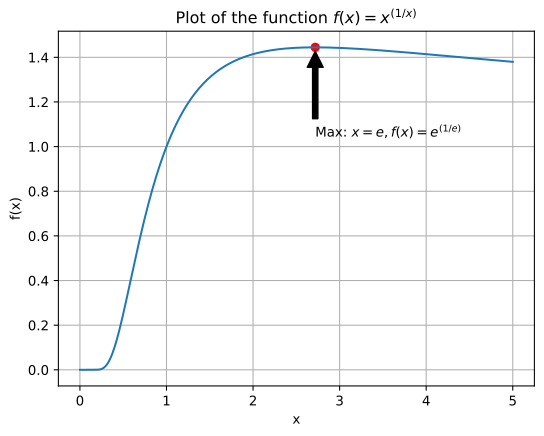
Note the function f(x)=x1/xf(x) = x^{1/x}

To investigate how this function behaves, we need to take its derivative. But that's difficult.

Consider g(x)=ln(f(x))=ln(x)xg(x) = \ln(f(x)) = \dfrac{\ln(x)}{x}

Differentiate using product rule:

(uv)=uv+uv(u \cdot v)' = u' \cdot v + u \cdot v'

where u=ln(x),v=1/x,u=1/x,v=1/x2u=\ln(x), v = 1/x, u'=1/x, v' = -1/x^2

g(x)=1x1x+ln(x)1x2g'(x) = \dfrac{1}{x} \cdot \dfrac{1}{x} + \ln(x) \cdot \dfrac{-1}{x^2}

g(x)=1ln(x)x2g'(x) = \dfrac{1-\ln{(x)}}{x^2}

The derivative gg' is negative if ln(x)>1\ln(x) > 1

    g\implies g is decreasing for x>ex > e

    f\implies f is decreasing for x>ex > e because ln\ln is a monotonic transformation.

    f(e)>f(π)\implies f(e) > f(\pi) because e<πe<\pi

    e1/e>π1/π\implies e^{1/e} > \pi^{1/\pi}

    eπ>πe\implies e^\pi > \pi^e

Thus eπe^\pi is bigger.


Notes:

  1. This puzzle is usually considered easy because it is easy to ask and verify (using a calculator). But when solving, it is a more difficult than many of the hard puzzles here.

  2. Here's a plot of f(x)=x1/xf(x)=x^{1/x}

    plot

  3. This is a common question in placement tests. It would be a good idea to memorize that f(x)=x1/xf(x) = x^{1/x} is decreasing in the range x>ex > e. Using this, we can prove other variants.
    relation    using function
    eπe^{\pi} >> πe\pi^{e} f(x)f(x) at x=e,πx=e, \pi
    e2πe^{2 \pi} >> π2e\pi ^ {2e} f2(x)f^2(x) at x=e,πx=e, \pi
    eπ2e^{\pi^2} >> πe2\pi ^ {e^2} f(x)\sqrt{f(x)} at x=e2,π2x=e^2, \pi^2
    eπe^{\sqrt{\pi}} << πe\pi ^ {\sqrt{e}} f(x)2f(x)^2 at x=e,πx=\sqrt{e}, \sqrt{\pi}