归来的探险家
The Returning Explorer
题目详情
一名探险家依次行走:
- 向南 1 英里
- 向东 1 英里
- 向北 1 英里
结果回到了出发点。此时他看到一只熊,问熊是什么颜色?
提示:地球表面是曲面,不是平面。
英文原题
An explorer walks:
- 1 mile South
- 1 mile East
- 1 mile North.
And finds themselves back at the starting point. The explorer spots a bear, what is the color of the bear?
Hint
The surface of the Earth is curved, not flat.
解析
白色。
如果探险家从北极出发:
- 在北极向南走 1 英里离开北极点。
- 在该纬度向东走 1 英里(绕着以北极为中心、半径 1 英里的小圆走一段)。
- 再向北走 1 英里回到北极。
北极附近出现的熊是北极熊,因此颜色为白色。
英文解析
White
Solution
It is not possible to reach the starting point by taking three straight lines, at right angles. The directions North, East, West or South are defined by movement along latitudes and longitudes. Latitudes are all parallel, but longitudes converge at the poles, due to the spherical shape of the Earth. We can investigate the movement near these poles.
If the explorer is initially standing at the North Pole:
- Every direction from the North Pole is due South. The explorer walks 1 mile South, i.e. away from the North Pole.
- Walking due East keeps the same distance (one mile) from the North Pole. In other words, the explorer walks along the circumference of a circle with a radius of 1 mile, centered at the North Pole.
- Walking due north takes them back to the North Pole again.
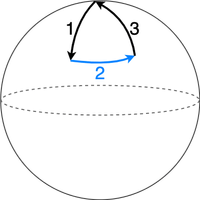
And a bear living at the North Pole must be a polar bear, which is white.
Follow-up Question
The North Pole is not the only point on Earth to satisfy this criterion. How many such points are there?
Follow-up Solution
Imagine if mile was the circumference of the circle along which the explorer walked East, then there can be more points that satisfy the condition.
Can this happen in reality - Yes!
Consider a circle of circumference 1 mile, centered at the south pole, with a radius of miles. If the explorer could start from 1 mile north of this circle, they will reach the starting point after moving 1 mile south, 1 mile east (entire circle) and 1 mile north. Hence, any point located at about miles away from the south pole satisfies this condition (infinite points).
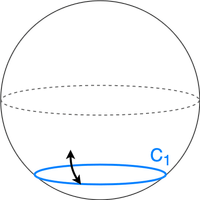
But wait, there is more! We can also have a circle of circumference miles, such that the explorer makes two turns around this circle while moving East. In general, the explorer can start from any point with the radius for any natural number .
The curious case near the South Pole
In the above formula, as increases, the latitude circles keep shrinking. Eventually down to the South Pole itself. Incidentally, moving East while standing on the South Pole is either impossible or equivalent to spinning. But if standing still is a valid movement towards the East, then the explorer can start anywhere on the latitude (circle) with a radius of 1 mile, centered at the South Pole, and reach the starting point after traveling for three miles, although it is debatable that the explorer only traveled for two miles.