三元组
Triads
题目详情
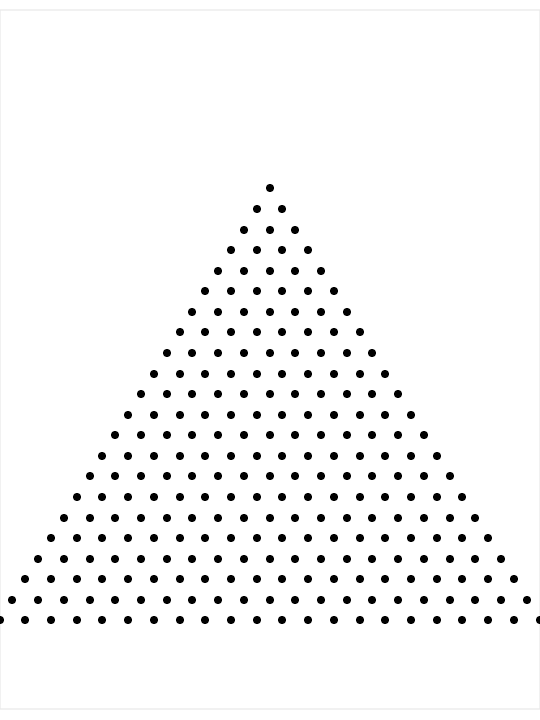
Consider an equilateral triangular grid of dots with N rows, such as
the one presented here (with N = 22). A “triad” is a set of 3 dots
where each dot in the triad borders the other two. The top two rows
the triangular grid form a triad; all triads are (rotations of)
precisely this shape.
For some values of N, it is possible to separate the triangular grid
into disjoint triads such that every dot is a part of one triad. For
example, it is obviously possible when N=2, but not when N=3 or N=4.
What is the sum of all values of N < 40 for which it is possible?
英文原题
Consider an equilateral triangular grid of dots with N rows, such as the one presented here (with N = 22). A “triad” is a set of 3 dots where each dot in the triad borders the other two. The top two rows the triangular grid form a triad; all triads are (rotations of) precisely this shape.
For some values of N, it is possible to separate the triangular grid into disjoint triads such that every dot is a part of one triad. For example, it is obviously possible when N=2, but not when N=3 or N=4.
What is the sum of all values of N < 40 for which it is possible?
解析
英文解析
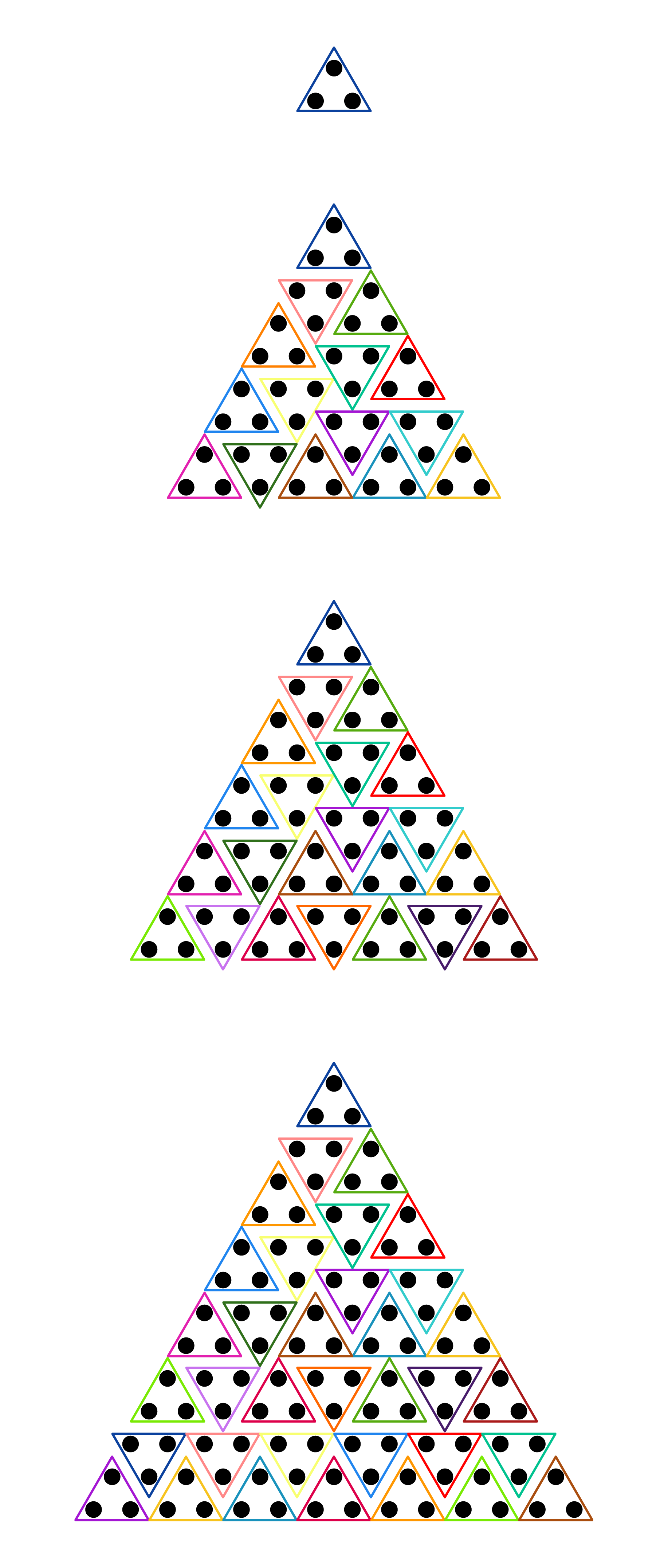
The answer to this month’s puzzle is 284. All numbers congruent to 0, 2, 9, or 11 mod 12 are able to be constructed, and no others are.
We can show that all of these numbers work. The arrangements for N = 2, 9, 11, and 12 are presented here. We can then add 12 rows to any of these 4 triangle sizes by adding an N=12 triangle, and a 12-by-N parallelogram, below them. We can construct those parallelograms by adding together 2×3 parallelograms until they are of the dimensions 12-by-N.
Proving that no other numbers work is… significantly more difficult (and part of the reason we cut things off at N=40). We didn’t realize this when we came up with this puzzle, but it turns out this problem has been investigated before by none other than the great John Conway, who the world sadly lost this past month. What a fortunate, if unintentional, tribute to Professor Conway. Here are links to his writings on the topic and to the OEIS page devoted to this sequence.
Congratulations to everyone who solved this month’s puzzle!