骑士动作 6
Knight Moves 6
题目详情
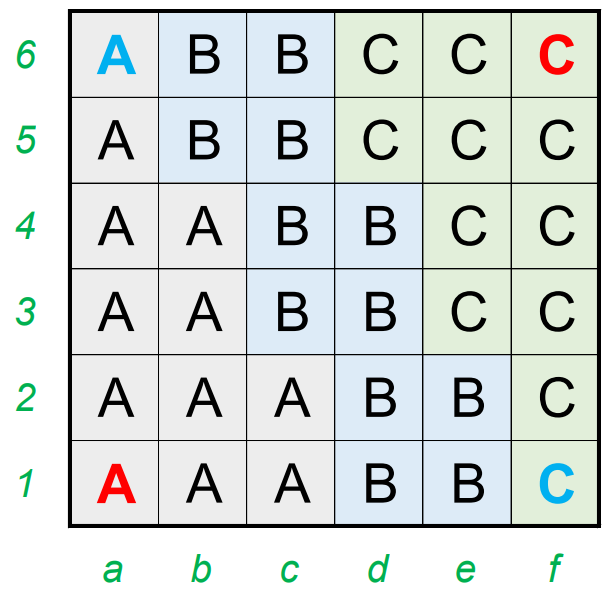
Pick distinct positive integers A, B, and C, and place them in the grid above. Your goal is to create two corner-to-corner trips — one from a1 to f6, and the other from a6 to f1 — both of which score exactly 2024 points.
A “trip” consists of knight’s moves. Squares may not be revisited within a trip.
The “score” for a trip is calculated as follows:
Start with A points.
Every time you make a move:
  if your move is between two *different* integers, **multiply** your score by the value you are moving to;
  otherwise, **increment** your score by the value you are moving to.
Can you find positive integers A, B, and C, as well as a pair of trips, that satisfy the criteria above? How low can you get A + B + C?
Please format your entry by concatenating your values for A, B, and C, followed by your a1-to-f6 tour, followed by your a6-to-f1 tour. For example, “1,2,253,a1,b3,c5,d3,f4,d5,f6,a6,c5,a4,b2,c4,d2,f1” would be a properly formatted entry.
To qualify for the leaderboard your value for A + B + C must be less than 50.
英文原题
Pick distinct positive integers A, B, and C, and place them in the grid above. Your goal is to create two corner-to-corner trips — one from a1 to f6, and the other from a6 to f1 — both of which score exactly 2024 points.
A “trip” consists of knight’s moves. Squares may not be revisited within a trip.
The “score” for a trip is calculated as follows:
- Start with A points.
- Every time you make a move:
- if your move is between two different integers, multiply your score by the value you are moving to;
- otherwise, increment your score by the value you are moving to.
Can you find positive integers A, B, and C, as well as a pair of trips, that satisfy the criteria above? How low can you get A + B + C?
Please format your entry by concatenating your values for A, B, and C, followed by your a1-to-f6 tour, followed by your a6-to-f1 tour. For example, “1,2,253,a1,b3,c5,d3,f4,d5,f6,a6,c5,a4,b2,c4,d2,f1” would be a properly formatted entry.
To qualify for the leaderboard your value for A + B + C must be less than 50.
解析
对于本月的谜题,求解者的任务是选择三个不同的正整数,这些正整数可以支持不止一个,而是两个个骑士在 6×6 棋盘上从角落到角落的旅程,每个得分恰好为 2024 分。
我们收到的近 40% 的条目设法实现了 A + B + C = 6 的最小总和。由于 C 需要成为 2024 年的除数,这意味着只有 4 种可能的排列:
-
(1, 3, 2) [所有条目中最受欢迎的一组值,出现了 214 次]
-
(3, 2, 1) [第二受欢迎,出现 86 次]
-
(3, 1, 2) [第三受欢迎; 54次]
-
(2, 3, 1) [第六受欢迎[1](#fn:1); 31次]
在我们收到的众多参赛作品中,我们想重点介绍一些:
最长的旅程 - a1到f6腿和a6到f1 - 来自Fred Vu,他选择了(3, 1, 2)并用32步棋来支持它a1,c2,a3,b1,d2,f3,e1,d3,b2,a4,c5,a6,b4,a2,c1,b3,a5,c4,e5,c6,d4,b5,d6,f5,e3,d5,f4,e2,c3,d1,f2,e4,f6和理论上最大的34步a6,c5,d3,e1,f3,e5,c6,a5,b3,a1,c2,a3,b1,d2,c4,b6,a4,b2,d1,f2,e4,f6,d5,f4,e6,d4,e2,c1,a2,c3,b5,d6,f5,e3,f1。。
-
“乘法”移动次数最多的旅程 (16) 来自 Justin Snopek,他也选择了 (3, 1, 2),其 a6-to-f1 路径为a6,c5,a4,c3,a2,c1,e2,f4,d5,b6,c4,e5,d3,f2,d1,e3,f5,d4,f3,d2,f1。
在我们收到的许多条目中,理论下限达到了 12 次总移动(每次旅程 6 次),我们收到的 A + B + C 的最低值为 19。我们收到的第一个完成此任务的条目来自 Shyam Padmanabhan,他选择了 (4, 7, 8) 并通过旅程 a1,b3,d4,c6,b4,d5,f6 和 a6,b4,c6,d4,c2,e3,f1 来支持它。
有一些三元组(A、B、C)我们只收到过一次。总和最小的是 (2, 1, 4),由 Richard Turner 提供;其伴随行程为a1,b3,d2,f1,e3,d5,f4,e2,c3,a2,b4,c2,e1,d3,f2,d1,b2,c4,d6,e4,f6 a6,c5,e4,f2,d1,c3,b5,a3,c2,d4,c6,b4,d5,f4,e2,c1,b3,d2,f1。
在 C 的九个可能值(即 2024 年的除数不大于 47)中,条目中最受欢迎的是 2,出现在 335 个条目中。之后,最受欢迎的是 4(167 条)、8(153 条)、1(126 条)、22(99 条)、11(84 条)、23(17 条)、44(4 条)和 46(2 条)。 (46 也是所有条目中出现的最大整数,仅出现在这 2 个条目中。)
最后,恰好零个条目中出现的最小正整数是……19。
恭喜所有向我们发送有效参赛作品的人!
1. \$1
英文解析
For this month’s puzzle, solvers were tasked with picking three distinct positive integers that could support not one but two corner-to-corner knight’s journeys on a 6-by-6 board, each scoring exactly 2024 points.
Nearly 40% of the entries we received managed to achieve a minimal sum of A + B + C = 6. Since C needed to be a divisor of 2024, this meant there were only 4 plausible permutations:
- (1, 3, 2) [the most popular set of values across all entries, appearing 214 times]
- (3, 2, 1) [the next most popular, appearing 86 times]
- (3, 1, 2) [third-most popular; 54 times]
- (2, 3, 1) [sixth-most popular1; 31 times]
Of the many entries we received, we would like to highlight a few:
-
The longest journeys – for both the a1-to-f6 leg and for a6-to-f1 – came from Fred Vu, who chose (3, 1, 2) and supported it with the 32-move a1,c2,a3,b1,d2,f3,e1,d3,b2,a4,c5,a6,b4,a2,c1,b3,a5,c4,e5,c6,d4,b5,d6,f5,e3,d5,f4,e2,c3,d1,f2,e4,f6 and the theoretically-maximal 34-move a6,c5,d3,e1,f3,e5,c6,a5,b3,a1,c2,a3,b1,d2,c4,b6,a4,b2,d1,f2,e4,f6,d5,f4,e6,d4,e2,c1,a2,c3,b5,d6,f5,e3,f1.
-
The journey with the largest number of “multiply” moves (16) came from Justin Snopek, who also chose (3, 1, 2) and whose a6-to-f1 path went a6,c5,a4,c3,a2,c1,e2,f4,d5,b6,c4,e5,d3,f2,d1,e3,f5,d4,f3,d2,f1.
-
Of the many entries we received that achieved the theoretical lower bound of 12 total moves (6 for each journey), the lowest value for A + B + C we received was 19. The first entry we received to accomplish this came from Shyam Padmanabhan, who picked (4, 7, 8) and supported it with the journeys a1,b3,d4,c6,b4,d5,f6 and a6,b4,c6,d4,c2,e3,f1.
-
There were a handful of triples (A, B, C) that we received exactly once. The one with the lowest sum was (2, 1, 4), courtesy of Richard Turner; its accompanying trips were a1,b3,d2,f1,e3,d5,f4,e2,c3,a2,b4,c2,e1,d3,f2,d1,b2,c4,d6,e4,f6 and a6,c5,e4,f2,d1,c3,b5,a3,c2,d4,c6,b4,d5,f4,e2,c1,b3,d2,f1.
Of the nine plausible values for C – i.e. divisors of 2024 no larger than 47 – the most popular among entries was 2, appearing in 335 entries. After that, the most popular were 4 (167 entries), 8 (153), 1 (126), 22 (99), 11 (84), 23 (17), 44 (4) and 46 (2). (46 was also the largest integer to occur in any entry, appearing in just those 2.)
And finally, the least positive integer to appear in exactly zero entries was… 19.
Congrats to everyone who sent us a valid entry!
-
(4, 7, 8) and (1, 5, 2) were the most popular among those that did not achieve the minimal sum. ↩