圆周时刻
Circle Time
题目详情
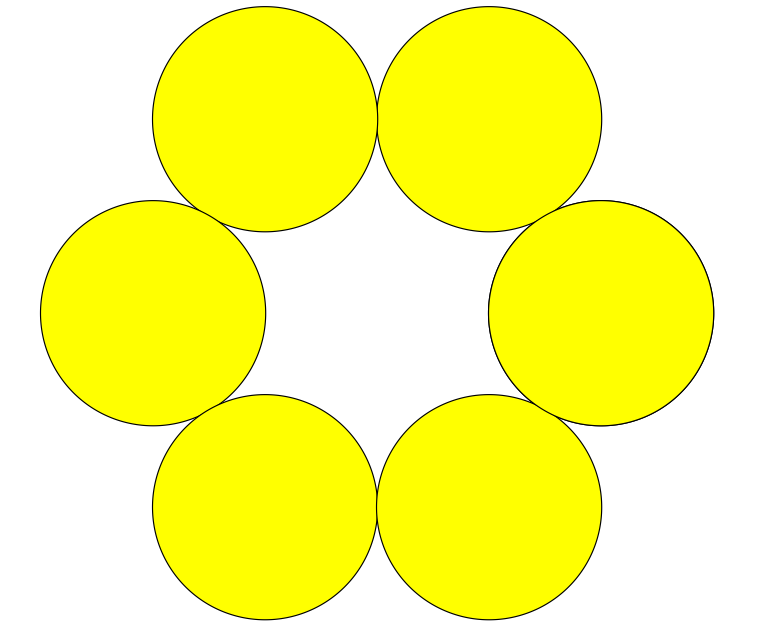
Call a “ring” of circles a collection of six circles of equal radius,
say r, whose centers lie on the six vertices of a regular hexagon with
side length 2r. This makes each circle tangent to its two neighbors,
and we can call the center of the regular hexagon the “center” of the
ring of circles. If we are given a circle C, what is the maximum
proportion of the area of that circle we can cover with rings of
circles entirely contained within C that all are mutually disjoint and
share the same center?
When submitting an answer, you can either send in a closed-form
solution, or your answer out to 6 decimal places.
Note:
This puzzle was inspired by the math problems posted at
https://www.janestreet.com/bonus-problems/.
We are publishing our video series Real
Numbers,
about problem-solving for high school students with a passion for
math, to
YouTube
over the next few weeks. These problems were released to celebrate the
occasion. Enjoy!
英文原题
Call a “ring” of circles a collection of six circles of equal radius, say r, whose centers lie on the six vertices of a regular hexagon with side length 2r. This makes each circle tangent to its two neighbors, and we can call the center of the regular hexagon the “center” of the ring of circles. If we are given a circle C, what is the maximum proportion of the area of that circle we can cover with rings of circles entirely contained within C that all are mutually disjoint and share the same center?
When submitting an answer, you can either send in a closed-form solution, or your answer out to 6 decimal places.
Note: This puzzle was inspired by the math problems posted at https://www.janestreet.com/bonus-problems/. We are publishing our video series Real Numbers, about problem-solving for high school students with a passion for math, to YouTube over the next few weeks. These problems were released to celebrate the occasion. Enjoy!
解析
英文解析
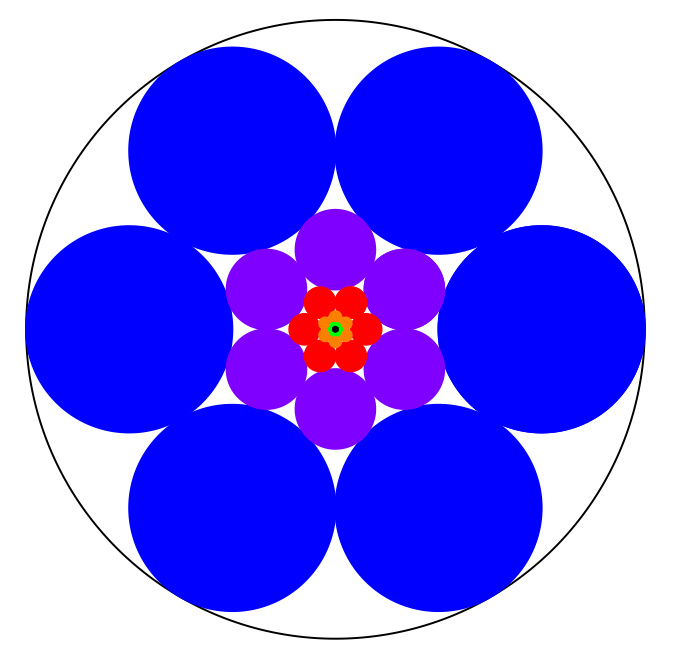
Suppose C has radius 1. Then the radius for each of the circles in a ring inscribed in C can be shown to be 1/3.
For the next ring, the largest radius one can achieve is if we rotate the ring by 30 degrees, in which case we get a maximum radius1 of (2 + 4 Sqrt[3] − 4 Sqrt[1 + Sqrt[3]])/18.
The total area covered by the infinite set of nested rings can then be calculated using a geometric series. The fraction that is covered comes to
6/(9 - (1 + 2 Sqrt[3] − 2 Sqrt[1 + Sqrt[3]])2),
which to 6 decimal places is .783464.
Congrats to this month’s solvers!
-
Corresponding to the positive solution to the equation r2 + (2/3 − r Sqrt[3])2 = (1/3 + r)2. ↩