差点魔法
Almost Magic
题目详情
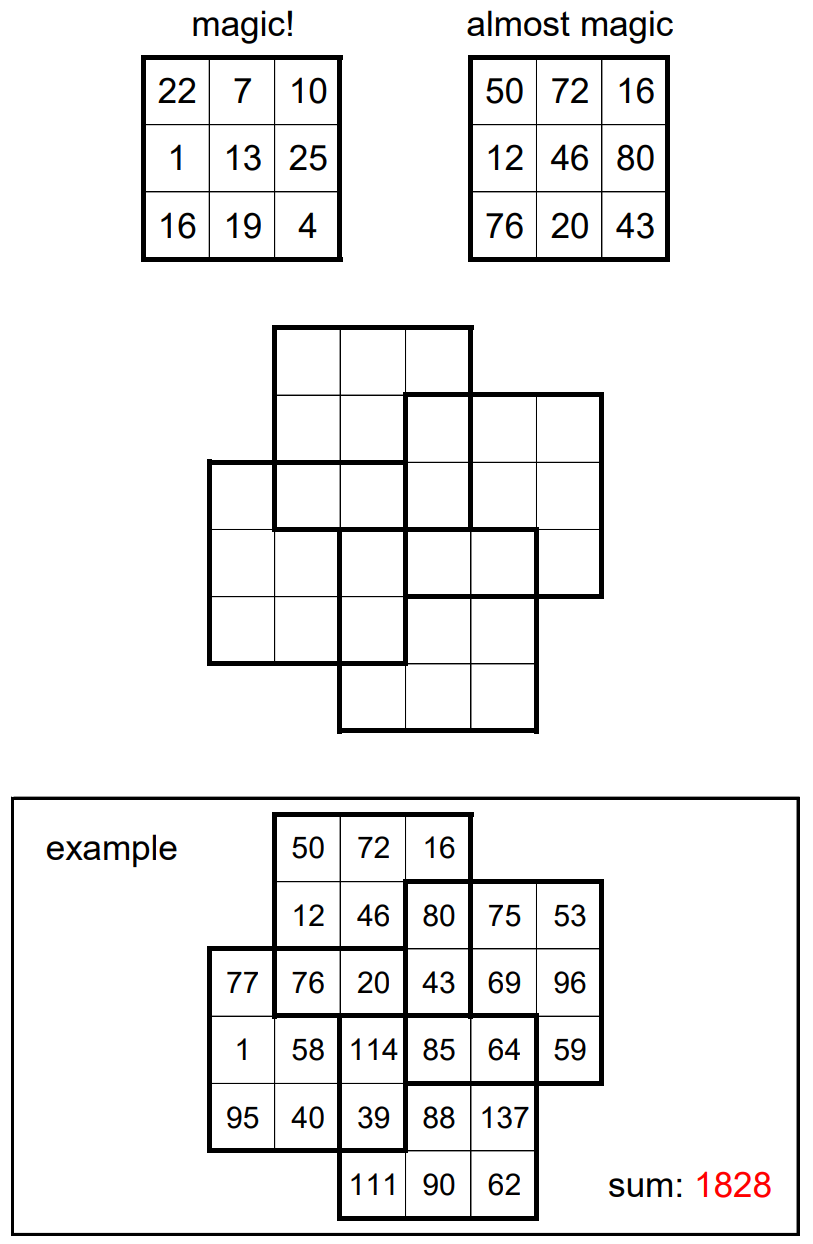
For the purposes of this puzzle, define a magic square to be a 3-by-3 grid of positive integers for which the rows, columns, and two diagonals all have the same sum. An example is shown top left; the 8 sums all equal 39.
An almost magic square is, well, almost a magic square. It differs from a magic square in that the 8 sums may differ from each other by at most 1. An example is shown top right; the sums are all 138 or 1391.
For this puzzle, place distinct positive integers into the empty grid above such that each of four bold-outlined 3-by-3 regions is an almost magic square. Your goal is to do so in a way that minimizes the overall sum of the integers you use.
[1] Not that it matters for this puzzle, but a magic square is, technically, also an almost magic square.
英文原题
For the purposes of this puzzle, define a magic square to be a 3-by-3 grid of positive integers for which the rows, columns, and two diagonals all have the same sum. An example is shown top left; the 8 sums all equal 39.
An almost magic square is, well, almost a magic square. It differs from a magic square in that the 8 sums may differ from each other by at most 1. An example is shown top right; the sums are all 138 or 1391.
For this puzzle, place distinct positive integers into the empty grid above such that each of four bold-outlined 3-by-3 regions is an almost magic square. Your goal is to do so in a way that minimizes the overall sum of the integers you use.
[1] Not that it matters for this puzzle, but a magic square is, technically, also an almost magic square.
解析
英文解析
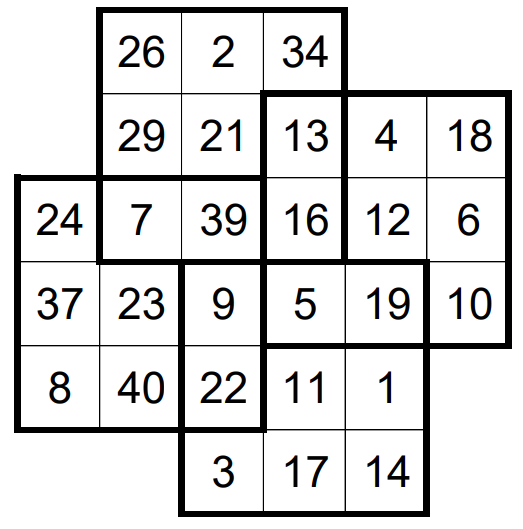
April’s challenge had solvers searching for a novel arrangement of almost magic squares with no repeated numbers. The lower the total sum of entries the better, and the best number achieved was 470. Above is an example of one of these optimal grids.
Congrats to this month’s solvers that were able to submit almost magic square arrangements with acceptably-small total sum!