关箱子
Shut the Box
题目详情
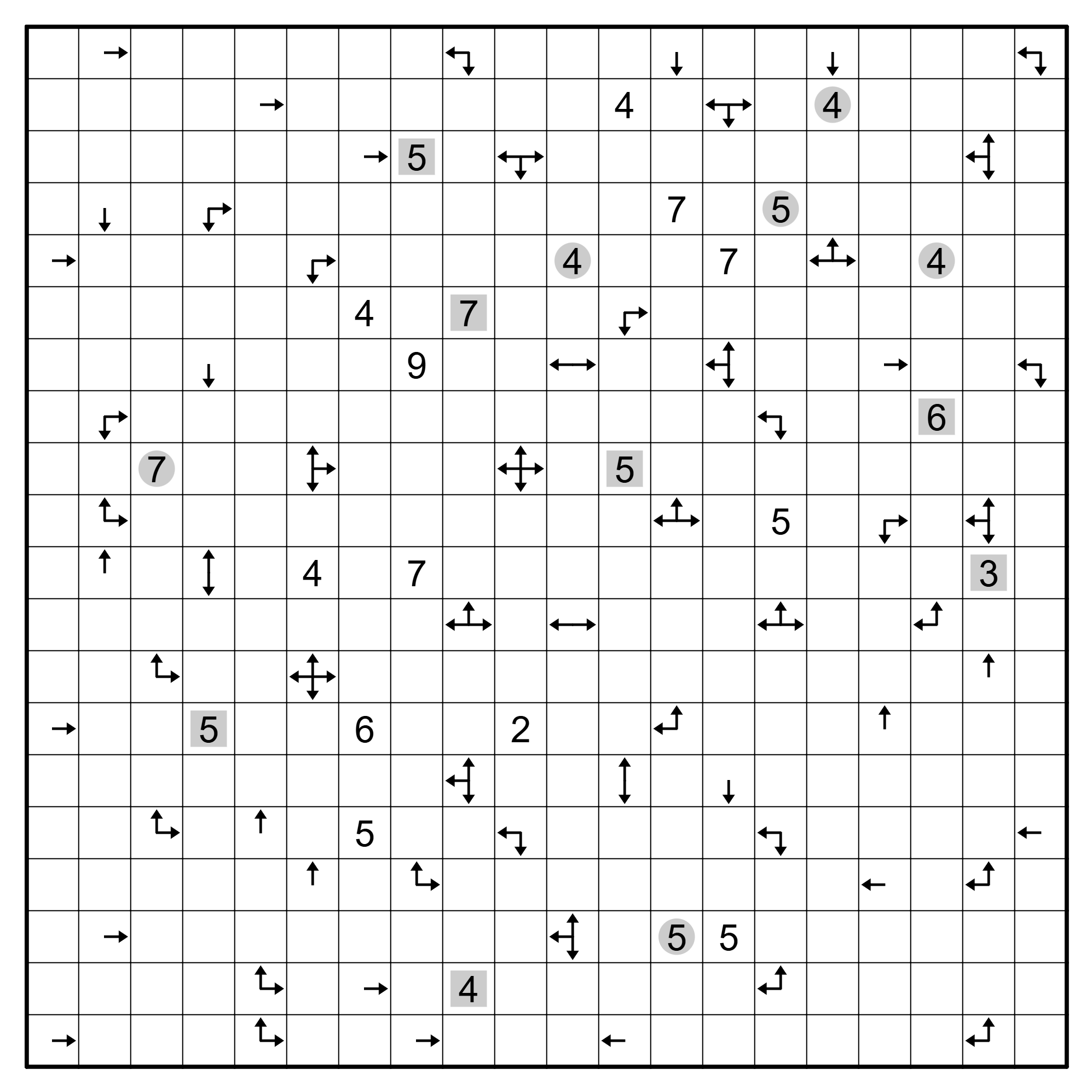
Use a scissors to cut away one or more groups of orthogonally connected cells (squares) from the grid above. Any group you cut away must have at least one cell along the boundary of the grid. The remaining cells must be orthogonally connected and not have any holes.
It must be possible to fold along some of the grid lines so that the remaining cells form the six walls of a rectangular solid (the “box”). There may not be any overlapping cells in the box.
Some cells have been labeled with arrows. These cells are not part of the box, but instead point in the direction(s) of the nearest box cells (looking in that square’s row and column).
Some cells have been labeled with numbers. These cells are part of the box. A number indicates how many cells within one king’s move of that cell are a part of the box. (Including the numbered cell.)
When the box is assembled, each grey circle should be directly opposite1 another grey circle. Each gray square should be orthogonally adjacent to (and on the same face as) another gray square.
Once you have assembled the box, compute, on each face, the sum of the numbered cells. The answer to this puzzle is the product of these six sums.
An example grid can be seen here. Pictures of the solved region and assembled box for the example grid can be seen here.
(That is, the line segment connecting “opposite” circles should be orthogonal to the faces containing them.) ↩
英文原题
Use a scissors to cut away one or more groups of orthogonally connected cells (squares) from the grid above. Any group you cut away must have at least one cell along the boundary of the grid. The remaining cells must be orthogonally connected and not have any holes.
It must be possible to fold along some of the grid lines so that the remaining cells form the six walls of a rectangular solid (the “box”). There may not be any overlapping cells in the box.
Some cells have been labeled with arrows. These cells are not part of the box, but instead point in the direction(s) of the nearest box cells (looking in that square’s row and column).
Some cells have been labeled with numbers. These cells are part of the box. A number indicates how many cells within one king’s move of that cell are a part of the box. (Including the numbered cell.)
When the box is assembled, each grey circle should be directly opposite1 another grey circle. Each gray square should be orthogonally adjacent to (and on the same face as) another gray square.
Once you have assembled the box, compute, on each face, the sum of the numbered cells. The answer to this puzzle is the product of these six sums.
An example grid can be seen here. Pictures of the solved region and assembled box for the example grid can be seen here.
-
(That is, the line segment connecting “opposite” circles should be orthogonal to the faces containing them.) ↩
解析
英文解析
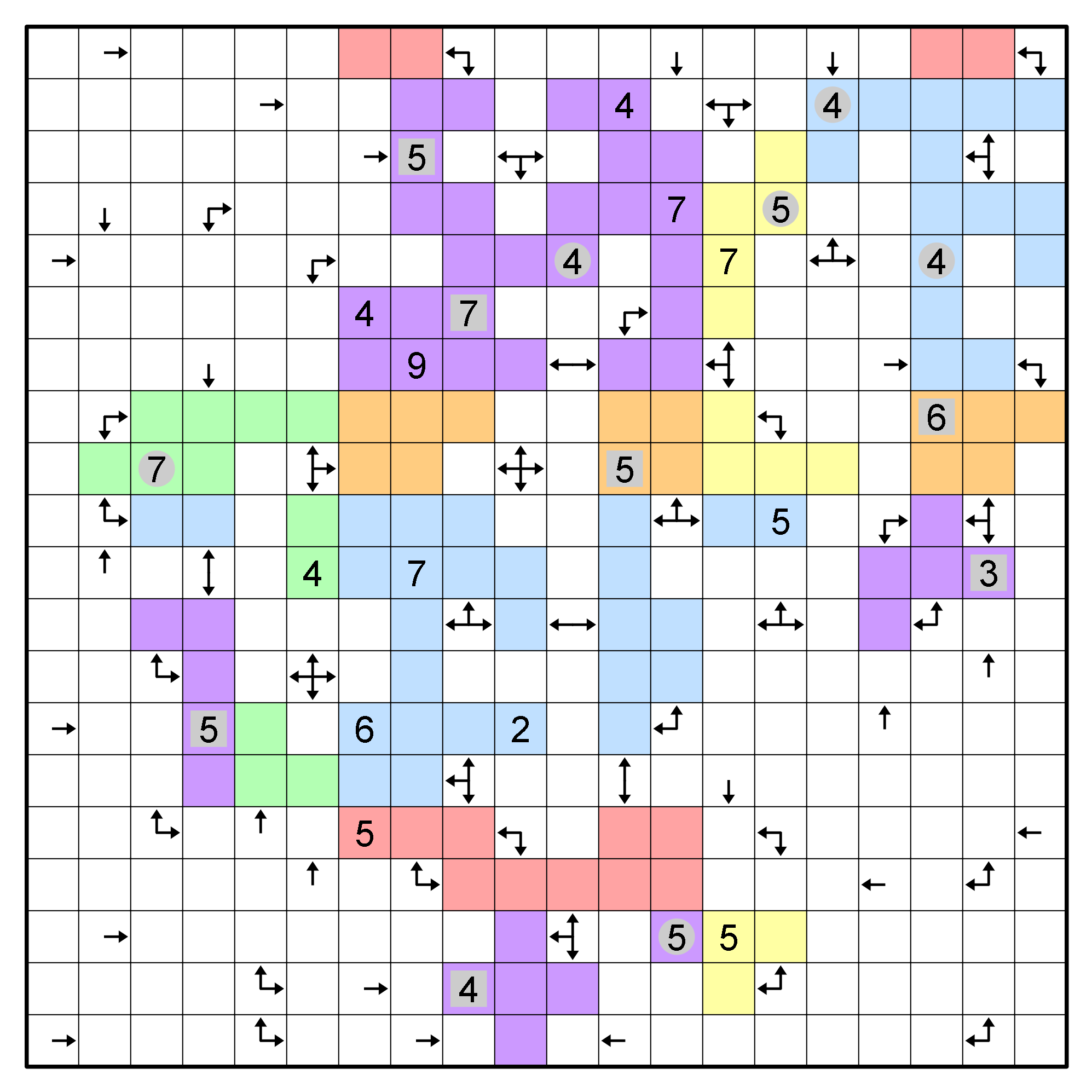
The diagram above is shaded to show the cells that remain, and which can be foldified to form a 2×6×7 box. The product of the ‘‘sum of the numbered cells’’ values for the six faces is 16414860.
Congrats to everyone who assembled the box!