挂钩 11
Hooks 11
题目详情
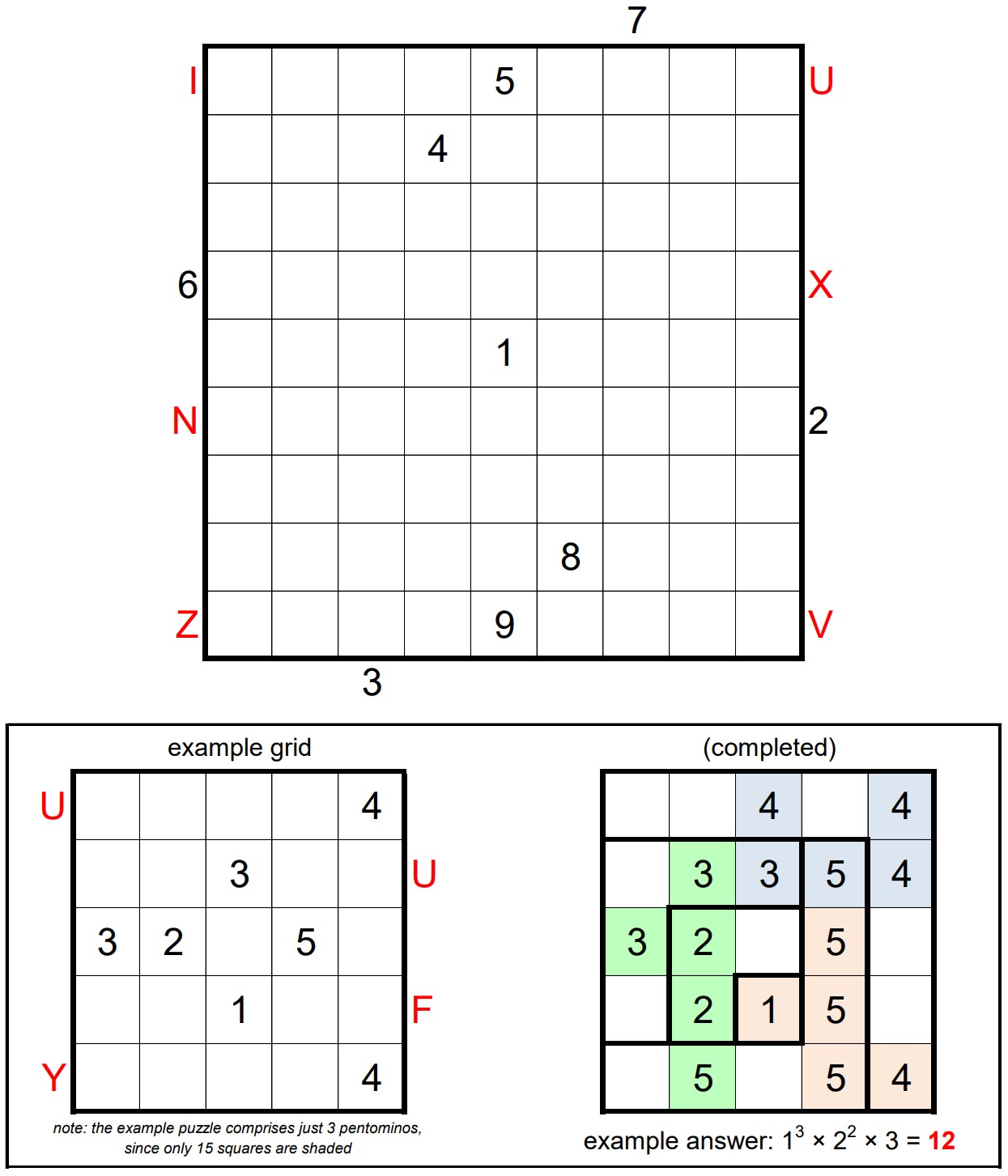
The grid above can be partitioned into 9 L-shaped “hooks”. The largest is 9-by-9 (contains 17 squares), the next largest is 8-by-8 (contains 15 squares), and so on. The smallest hook is just a single square. Find where the hooks are located, and place nine 9’s in one of the hooks, eight 8’s in another, seven 7’s in another, and so on.
The filled squares must form a connected region. (Squares are “connected” if they are orthogonally adjacent.) Furthermore, every 2-by-2 region must contain at least one unfilled square.
The set of filled squares must be decomposable into 9 distinct pentominos, with no repeated shapes (including reflection or rotation). Finally, the sum of the of the values in each pentomino must be a multiple of 5.
A value outside the grid denotes the either first number or pentomino1 (from the decomposition) seen when looking into that row or column.
The answer to this puzzle is the product of the areas of the connected groups of empty squares in the completed grid.
Using the canonical pentomino naming scheme – F, I, L, N, P, T, U, V, W, X, Y, Z. ↩
英文原题
The grid above can be partitioned into 9 L-shaped “hooks”. The largest is 9-by-9 (contains 17 squares), the next largest is 8-by-8 (contains 15 squares), and so on. The smallest hook is just a single square. Find where the hooks are located, and place nine 9’s in one of the hooks, eight 8’s in another, seven 7’s in another, and so on.
The filled squares must form a connected region. (Squares are “connected” if they are orthogonally adjacent.) Furthermore, every 2-by-2 region must contain at least one unfilled square.
The set of filled squares must be decomposable into 9 distinct pentominos, with no repeated shapes (including reflection or rotation). Finally, the sum of the of the values in each pentomino must be a multiple of 5.
A value outside the grid denotes the either first number or pentomino1 (from the decomposition) seen when looking into that row or column.
The answer to this puzzle is the product of the areas of the connected groups of empty squares in the completed grid.
-
Using the canonical pentomino naming scheme – F, I, L, N, P, T, U, V, W, X, Y, Z. ↩
解析
英文解析
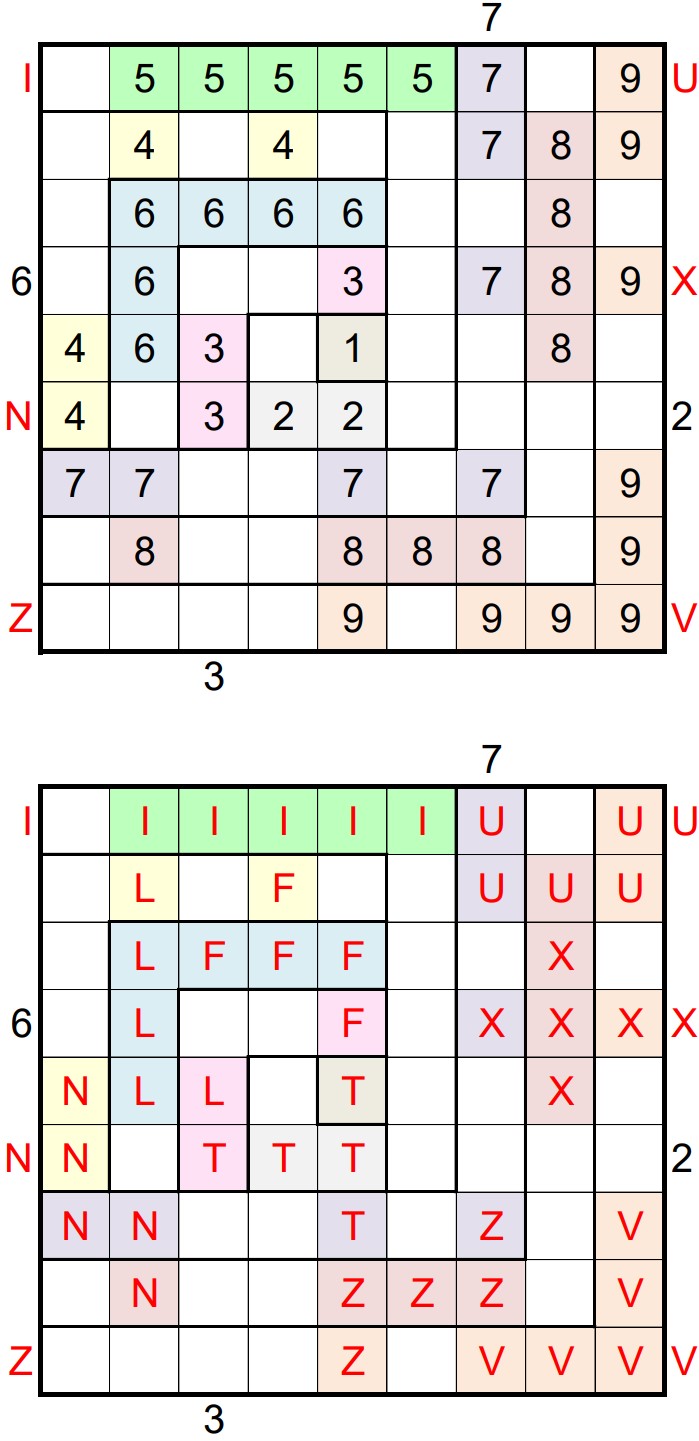
The above image shows the completed grid, first with numbers assigned and second with pentomino letters labeled. The product of the empty regions is 1620. Quick note that 1296 was the most common incorrect answer submitted, which is what you get if you slide the I pentomino composed of 5’s to the left one square. Alas, that arrangement leaves the filled squares in two disconnected regions so is not a valid arrangement.
Congrats to this month’s solvers!